(originally written November,1992)
Cape Hatteras School opened in Buxton in 1955. Before Cape Hatteras School was built each village had its own school, although many of these schools were not accredited because of the small number of students. In this case a student wishing to receive a high school diploma had to either travel to another village or attend school off of the island. The villagers worked hard to keep their individual schools open as they wanted to keep their children close to home. Because the roads were unpaved on Hatteras Island until the late 1940s, travel between villages involved along a slow difficult drive on sand trails. This made it hard for students to make a daily trip to other villages to go to school. If the parents of a child could not afford to pay room and board for their child to attend an accredited school, that child would not be able to get a diploma.
In 1926, Avon’s school had four teachers including Sigsby Miller. The school taught kindergarten through the twelfth grade, although it was not accredited. Many of the students completed their education at other schools or enlisted in the Coast Guard as their career. Some of the students graduated from the high school that was in Buxton located on Light Plant Road.
In 1931, a new principal arrived in Avon. This was to be his first job after graduating from the University of North Carolina in 1930. Stanley E Green made the long trip from the western region of North Carolina to the Outer Banks, at that time an area mostly untamed by civilization. He remained in Avon as principal until 1942 when he left in order to join the Coast Guard and serve his country during World War 2. Mr. Green wrote a book about his life in Avon called the Kinnakeet Adventure. The following information was taken from his book, which is now out of print.
The school that Mr. Green took charge of upon his arrival was in terrible shape as a result of a recent storm. The first day of class was held with no textbooks or blackboards available. Lessons had to be dictated to the students. After a short amount of time the school was cleaned up by the children who had canvassed the village for contributions of supplies. Over the course of that first fall, a routine was established, although the teachers and students had to learn to improvise with whatever equipment was available.
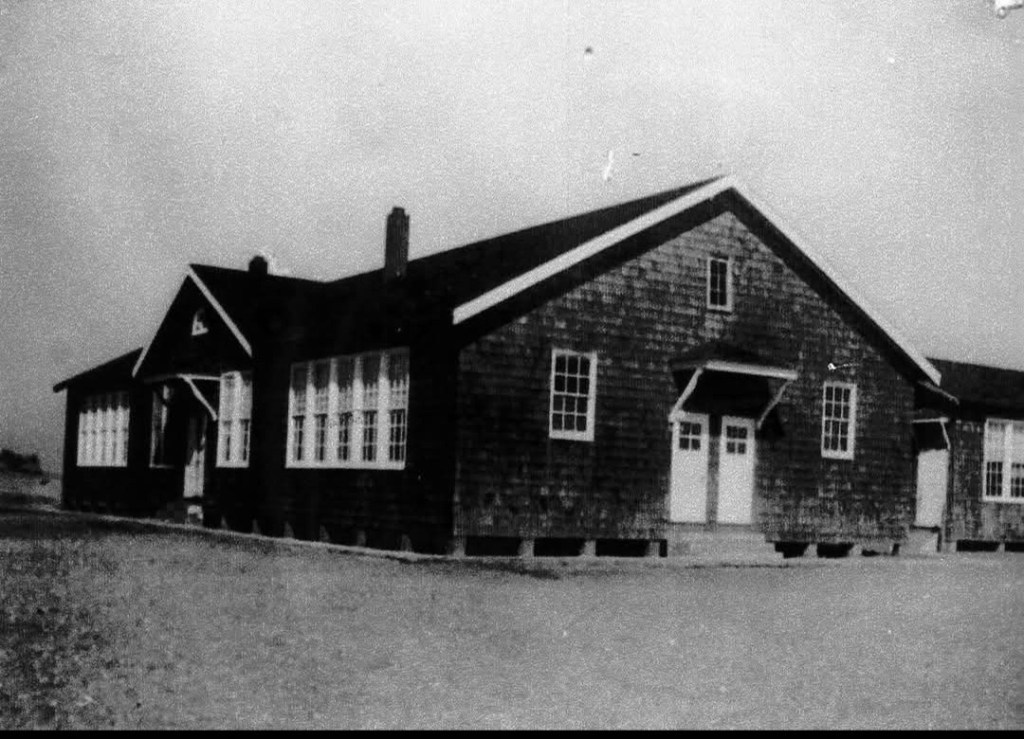
While Mr. Green was attending a meeting in Matteo in March of 1932, a severe storm hit the Outer Banks. The school building was damaged beyond repair. The Board of Education was going to close school in Avon for the rest of the school year but the villagers were able to keep school going by offering the use of their homes. In the fall of 1932, a new school opened in Avon north of the old school. It was a long frame structure with four large classrooms and an auditorium. The high school was accredited for a few years and then was to lose that status because of a drop in enrollment. George Meekins came up with a solution to this problem by going home to home recruiting adults who had never had a chance to graduate from high school. 35 adults enrolled. The combination of youth and age worked very well. As a result of attending school, the adults learned how badly the school needed books and donated $300 to start a library. Although the villagers worked hard to keep their school, eventually the school lost its accreditation.
The teachers in Avon had quite a job on their hands. Not only did they have to deal with the lack of materials but their students were often unruly and hard to control. Although the girls were usually well behaved, the boys were sometimes wild. They were used to being outdoors fishing and hunting.
The mothers of these boys spent a lot of time finding their sons out on the creeks or by the sound and dragging these reluctant pupils away from their glorious day of playing hooky. It was hard for a young boy to imagine what the schoolroom could ever offer to compare with the glories of the great outdoors. My father was one of those boys. But they went because their parents made them go and as they got older they discovered that the schoolroom had at least one advantage, some of the students were girls!
The unique challenges of the village schoolhouses are gone now. But it’s good to remember the days of the local schoolhouse and if you listen real hard along the creeks and landings, you may still be able to hear the echo of a mother searching for her hooky playing son.
Avon Schoolhouse built in 1932

Top row: David Meekins, Harold Gray, Bobby Gray, Mrs. Kelly -teacher, Roxie Hooper
Middle row: Yvonne Gray (Hooper), Gloria Williams (O’Neal), Rita Scarborough (Hooper), Faye Gray, Alma Porter, Anna Scarborough (Gray), Phyllis Gray, Lillian Gray, Olga Meekins, Vivian Gray (Scarborough)
Bottom row: Johnny Miller, L.P. O’Neal, Bembry Miller, Ebbie Hooper, John O’Neal
 Kinnakeet Home
My father Bembry Miller was one of the students that was mentioned and shown in the photo’s! He is still alive at 89, and love to show him these articles of his home. Born and raised in Avon, NC. My Dad was born 1935. His parents William Taft Miller and mother Irene Scarborough Miller were born and raised in Avon. Along with all his ancestors. Love to read about my family history!
LikeLike